5-Minute Speed-to-Lead for B2B Sales Ops: Routing, Precedence, Fallback

The routing architecture that wins in 2026 is a hybrid: account-based overrides first, territory and segment defaults second, score-based prioritization as a sorting layer, and a named fallback owner catching everything else. The single KPI to obsess over is speed-to-lead, with a target of first contact attempts within 5 minutes for Tier-1 inbound leads. Get the sequencing wrong and even the fastest dialer in the world routes leads to the wrong desk.
TL;DR:
- Account-based routing should always evaluate before territory or segment defaults to ensure relationship continuity and prevent misroutes.
- Speed-to-lead remains the primary KPI, with a target of first contact within 5 minutes for Tier-1 inbound leads, to maximize conversion chances.
- Routing rules must follow a strict precedence order, including account match, named lists, territory, score, and finally round-robin, with documented ownership.
- Effective lead segmentation relies on high-quality firmographic, geographic, account, behavioral, and real-time rep signals, normalized within the CRM.
- Regular review, testing, and rollback plans are critical, along with prioritizing speed and governance to prevent rule decay and revenue leakage.
Table of Contents
- Core Lead-Routing Models and When to Use Each
- What Data Does Effective Lead Segmentation Actually Require?
- How Should You Set Rule Precedence and Governance?
- Handling Out-of-Office Reps, Overflow, and No-Match Leads
- Hybrid Design Patterns: How Teams Actually Combine Models
- What Metrics Actually Tell You Routing Is Working?
- CRM and Automation Checklist for Rolling Out Routing Rules
- How RevRing Implements These Routing Strategies
- Author Perspective: Tradeoffs and Three Actions to Start This Week
- RevRing as a Practical Implementation Path
- Sources
Core Lead-Routing Models and When to Use Each
Every lead distribution technique falls into one of five buckets, and most mature revenue operations teams end up running three or four of them simultaneously, layered rather than chosen in isolation.
Round-robin assigns leads sequentially across a rep pool. It requires almost no data, which makes it the default for small teams without segmentation logic yet built. Its failure mode shows up the moment reps have different quotas, skill levels, or availability. A rep on vacation still gets leads in strict rotation unless you build in capacity checks.
Territory routing assigns by geography, industry vertical, or company size band. It works well once you have clean firmographic data and a sales structure that mirrors those boundaries. It fails when territories are drawn on outdated org charts or when a lead’s geography field is missing or mistyped, which happens more often than most ops leaders expect.
Account-based routing matches inbound leads to the rep who already owns that account or a related one and the same parent company. This model protects relationship continuity above everything else. It requires a reliable account-matching layer, ideally tied to a firmographic data provider, because a fuzzy company-name match is where most account-based routing quietly breaks.
Score and priority-queue routing ranks leads by fit and intent signals, then routes the highest scores to your best closers or fastest responders first. It only works with enough historical conversion data to trust the score. Rolling it out before that data exists is one of the more common self-inflicted wounds in lead routing rules, where under-tested precedence order causes strong leads to sit while a scoring model calibrates itself.
Weighted routing distributes leads unevenly based on rep performance, seniority, or capacity. It rewards your top performers with more volume, but unmanaged weighting starves new reps of the reps they need to ramp. Practitioners recommend a probationary floor, a guaranteed baseline allocation for a rep’s first 90 days, so weighting doesn’t become a self-fulfilling prophecy that never lets anyone new catch up.
A few sequencing notes matter more than the models themselves:
- Layer models rather than picking one; account-based match should always evaluate before territory defaults.
- Score-based prioritization works best as a tiebreaker inside a territory or segment, not as the first filter.
- Round-robin should be your fallback layer, never your primary logic, once you have any segmentation data at all.
- Weighted variants need a review cadence, ideally monthly, to catch drift before it becomes a rep retention problem.
What Data Does Effective Lead Segmentation Actually Require?
Optimal lead allocation depends entirely on the quality of the fields feeding it. Garbage in, misrouted lead out.
Five categories of signal drive most routing decisions:
- Firmographic data: company size, revenue band, industry, and employee count, usually pulled from an enrichment provider at capture time.
- Geographic data: state, region, or country, standardized against a fixed list rather than free text.
- Account data: whether the lead matches an existing account, an open opportunity, or a named strategic list.
- Behavioral signals: page visits, content downloads, demo requests, and product usage for existing customers exploring an upsell.
- Rep-side signals: current capacity, time zone, language, and specialization, which routing logic needs just as much as it needs lead-side data.
Normalize fields at the CRM level before they ever touch routing logic. A “Texas” in one record and a “TX” in another will silently break a territory rule that assumes exact matches. Most CRMs support picklists or validation rules for exactly this reason, and skipping that setup is the single most common cause of misroutes traced back after the fact.
Inferred fields, like a lead-scoring model’s guess at company size when firmographic data is missing, carry real tradeoffs. They fill gaps, but they also introduce a layer of uncertainty that a human reviewing a misrouted lead can’t easily audit. Explicit fields, captured directly from a form or verified through enrichment, should always take precedence over an inferred value when both exist.
Pro Tip: Only build routing logic around signals you can capture in under a second, either directly at form submission or through real-time enrichment. If a data point takes an enrichment tool 30 seconds to return, your lead is already sitting in queue longer than your SLA allows.
How Should You Set Rule Precedence and Governance?
Undocumented rule order is where most lead assignment rules quietly rot. A rep leaves, a territory gets redrawn, someone adds an exception for one client, and six months later nobody can explain why leads from a specific domain go to the wrong queue.
The recommended precedence order, drawn from operational lead routing rules best practices, runs like this:
- Account match: does this lead belong to an existing account or open opportunity? Route to the owner immediately.
- Named lists and strategic ownership: is this a named target account, an enterprise prospect, or a partner referral with a designated owner?
- Territory or segment default: does the lead fall into a defined geography, vertical, or company-size band?
- Score or priority queue: within that segment, does this lead’s fit or intent score bump it ahead of others?
- Round-robin fallback: if nothing above applies, rotate it through the general pool.
Every rule in that stack needs a version history, an owner, and a documented test case. A rule with no owner is a rule nobody notices breaking. Operational guidance on separating deterministic constraints from AI-driven ranking makes the same point: keep eligibility rules (who can legally or contractually receive this lead) completely separate from any predictive ranking layer, and log the model version and decision path for every single assignment, so an audit six months later isn’t a guessing game.
Before shipping a rule change, run it against sample test records that cover the edge cases: a lead with no company name, one that matches two territories, one with a blank state field. If your CRM supports a sandbox or staging environment, simulate the new rule set against last month’s actual lead volume before flipping it live. A rollback plan, meaning a one-click way to revert to the previous rule version, should exist before you ever test in production.
Handling Out-of-Office Reps, Overflow, and No-Match Leads
Automated lead management only works if it accounts for the moments when the system itself hits a wall: a rep on vacation, a queue at capacity, or a lead that matches nothing.
Out-of-office handling should route to a designated backup rep, never straight to a manager. Managers already carry the highest lead volume in most org structures, and dumping OOO overflow onto them creates a second bottleneck exactly where you can’t afford one. Set a defined backup pairing for every rep before it becomes a problem, not after someone’s inbox floods during a two-week leave.
Capacity caps prevent any single rep from getting buried while others sit idle. Define a maximum open-lead count per rep, and route anything above that ceiling to a designated overflow pool rather than force-feeding it to whoever’s next in rotation.
No-match fallback needs a named owner, full stop. Unowned fallback queues are where leads quietly die, and fallback logic without an active owner and SLA turns directly into revenue leakage. Build one of three structures: an enrichment hold queue that attempts to fill missing fields before routing, a dedicated SDR triage lane for high-intent unmatched leads, or a monitored round-robin pool with a named daily reviewer.
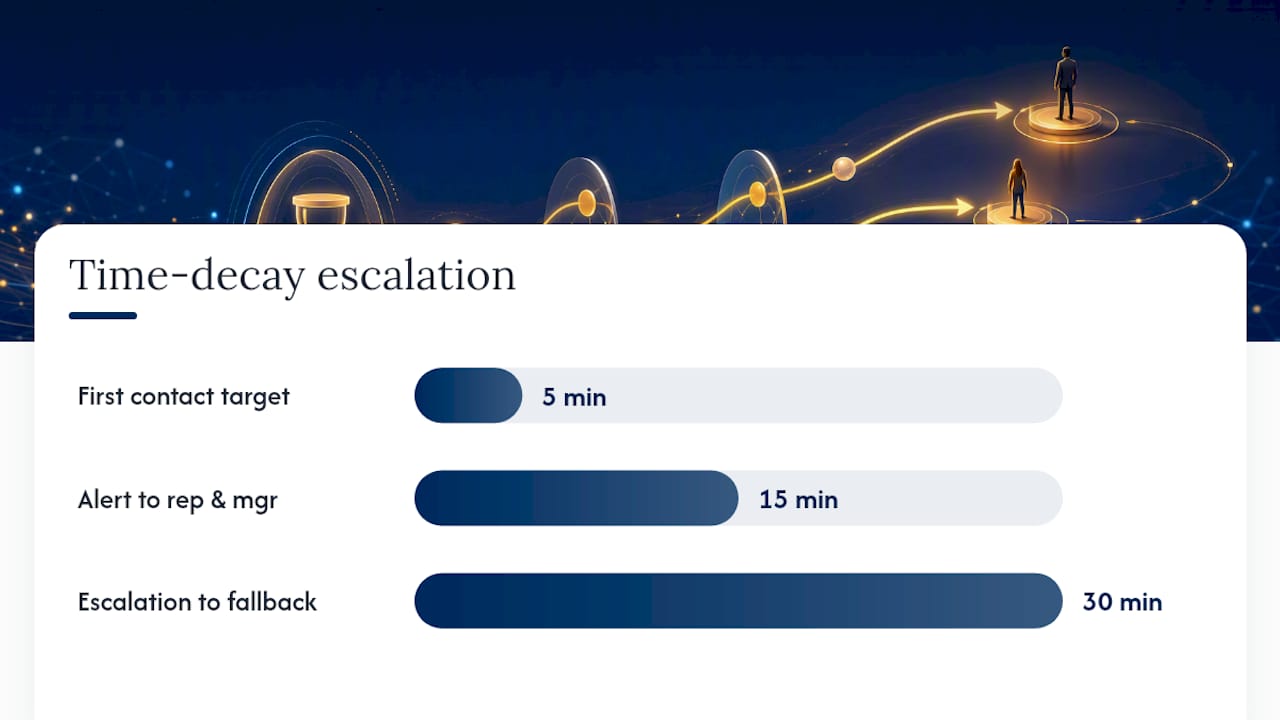
Time-decay escalation keeps SLA breaches from going unnoticed:
- 5 minutes: first contact attempt target for Tier-1 inbound leads.
- 15 minutes: automated alert to the assigned rep and their manager if no contact attempt is logged.
- 30 minutes: automatic escalation to the fallback pool or a designated closer for immediate action.
Speed matters because contact rates drop sharply the longer a lead waits, with some documented cases compressing response time from 20 minutes down to 60 seconds after a routing overhaul. Read more on why speed-to-lead drives so much of the conversion curve on its own.
Hybrid Design Patterns: How Teams Actually Combine Models
No serious revenue team runs a single routing model in isolation. The question is always how to combine them, and the answer usually depends on team size and how much historical data you’re sitting on.
Starter pattern (under 15 reps). Round-robin as the default, with a named-account override sitting on top. This is the fastest architecture to stand up and requires almost no historical data. It fails as soon as your team splits into specialists, but for a young sales floor it’s the right place to begin.
Scale pattern (15 to 75 reps). Territory or segment routing becomes the primary layer, with capacity caps preventing overload and a score-based sorting layer prioritizing which lead in a rep’s queue gets worked first. This is where most mid-market B2B sales organizations settle for a year or two, and it’s usually the pattern that exposes bad firmographic data for the first time.
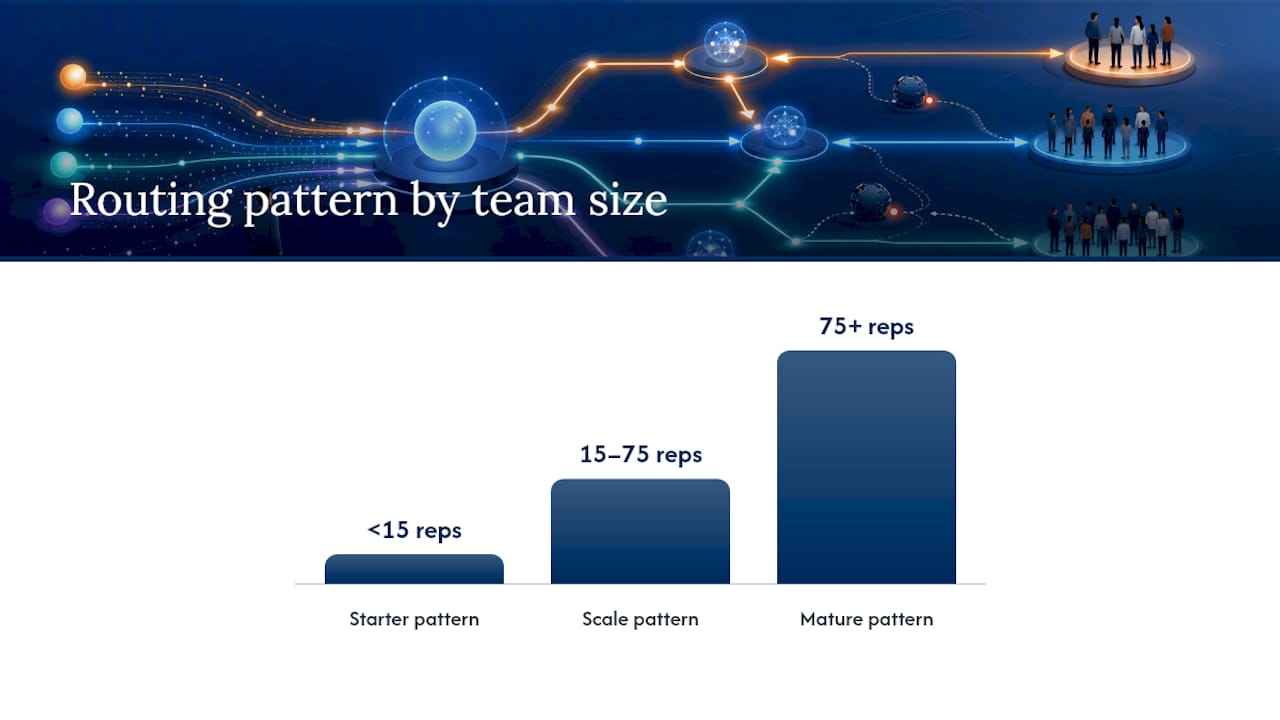
Mature pattern (75+ reps or high lead volume). Account-first matching runs before anything else, a predictive layer ranks eligible reps by likely conversion fit, and capacity caps adjust dynamically based on real-time rep load rather than static thresholds. This pattern needs continuous calibration, meaning someone reviews assignment outcomes weekly and adjusts scoring weights when conversion patterns shift.
A few rules apply across all three patterns:
- Don’t introduce score-based routing until you have at least 90 days of stable, reliable conversion-by-score data; earlier than that, scoring increases misroutes rather than reducing them.
- Weighted allocation, wherever it appears, needs the same 90-day probationary floor for new reps referenced earlier, or you’ll watch your best-performing reps get rewarded into burnout.
- Speed and fit are not the same axis, and optimizing only for speed can route quickly to the wrong rep, which does about as much damage as routing slowly to the right one.
- Revisit the pattern itself, not just the rules inside it, whenever headcount crosses one of these size thresholds.
What Metrics Actually Tell You Routing Is Working?
Most teams track close rate and stop there. That’s necessary but not sufficient. Routing health has its own dashboard, and it looks different from a standard sales scoreboard.
Primary KPI: speed-to-lead, measured as time from lead creation to first genuine contact attempt, not just an auto-email. Review speed-to-lead benchmarks against your own historical data monthly, since what counts as fast shifts as your lead volume and channel mix change.
Secondary metrics worth a permanent dashboard slot:
- Lead-to-contact rate, broken out by which routing method assigned the lead.
- Lead-to-opportunity conversion, again segmented by routing path, to catch a model that’s technically fast but converting poorly.
- Fallback queue volume, tracked week over week rather than as a single snapshot.
- Assignment skew, meaning how far individual rep loads deviate from the team average.
- SLA breach rate, the percentage of leads that missed their contact-attempt window entirely.
A rising fallback rate, quarter over quarter, is the most reliable early warning sign that your rules no longer match how the business actually operates. New product line, new territory carve-out, new rep structure, and the fallback pool swells before anyone notices in the top-line numbers.
Pro Tip: Build a single dashboard view combining fallback volume, assignment skew, and SLA breach rate side by side. Reviewed weekly, this trio catches routing decay months before it shows up as a dip in quarterly close rate. Analytics platforms like sales call analytics tools can help surface which reps are converting fastest by routing path, which sharpens where you recalibrate weighting.
CRM and Automation Checklist for Rolling Out Routing Rules
Automated lead management lives or dies on CRM configuration. Here’s the sequence that avoids the most common rollout mistakes:
- Standardize your fields first. Lock down picklists for state, industry, and company-size band before writing a single routing rule against them. Free-text fields break exact-match logic silently, and CRM deduplication practices matter here just as much as they do for reporting accuracy.
- Build an enrichment hold queue. For leads missing critical fields, route to a brief holding stage where an enrichment tool fills gaps before the lead ever reaches assignment logic. Cap the hold time at a few seconds, not minutes, or you undercut your own speed-to-lead SLA.
- Implement precedence in the actual rule engine, not just documentation. Most CRMs process rules top to bottom; sequence account-match rules above territory rules above round-robin, physically, in the tool.
- Separate deterministic rules from any AI ranking layer. Eligibility (can this rep legally or contractually take this lead) should never depend on a probabilistic model. Use AI or scoring only to rank among already-eligible reps.
- Write test cases before go-live. Include a lead with a blank field, one matching two territories, and one from a brand-new account with no history.
- Run a staging simulation against a recent month of real lead data before flipping rules live, and audit results the following week.
- Keep a rollback plan on hand. One rule version, one owner, one documented way to revert if the new logic misfires.
How RevRing Implements These Routing Strategies
A platform can map directly onto this architecture. Smart routing may support round-robin, skill-based, geo, and multi-buyer logic, layered rather than forced into a single model. A predictive dialer and blended inbound/outbound calling engine help keep speed-to-lead SLAs realistic, since a lead assigned inside a compliant, connected system reaches a rep faster than one bouncing between disconnected tools.
Industry-tailored workflows in healthcare and real estate build compliance checks, including TCPA and DNC screening, directly into the routing path, so fallback ownership and governance aren’t bolted on afterward. Clients scaling from a dozen agents to well over a hundred have kept routing rules intact through that growth, a direct test of whether precedence logic actually holds up under volume.
Author Perspective: Tradeoffs and Three Actions to Start This Week
Speed without governance just moves the chaos faster. The teams that get this right treat routing as infrastructure, not a one-time setup task.
Three moves worth making this week: document your current territory and account-match rules in writing, even if they only live in someone’s head today; turn on real-time enrichment for the two or three fields most often missing at capture; and set a hard SLA, 5 to 15 minutes, with an alert at the 15-minute mark. If your fallback queue or SLA breach rate has climbed in the last quarter, that’s your signal to run a full routing audit now, not next quarter.
— Marc
RevRing as a Practical Implementation Path
Building this hybrid architecture from scratch inside a patchwork of disconnected tools is where most teams lose months. RevRing gives you the routing logic, the compliance layer, and the connected CRM in one system, so account-based overrides, territory defaults, and score-based prioritization run against the same clean data instead of three tools that don’t talk to each other.
The platform’s AI and automation tools handle the ranking layer this guide recommends, while the predictive dialer puts reps on the phone inside your SLA window instead of hours later. If your rules currently live in someone’s memory or a spreadsheet nobody trusts, that’s the exact gap RevRing’s connected CRM was built to close. See the platform overview and schedule a live demo to walk through your own routing rules with the team.