4 Essentials for 2026 HIPAA Compliant Outreach for U.S. Healthcare Admins
Yes, you can run HIPAA compliant outreach, but only if four things are locked down first: a signed BAA with every vendor touching PHI, encryption and access controls configured correctly, documented patient consent by channel, and messaging that sticks to the minimum necessary. Skip any one of these, and your outreach program is exposed. Recordings, voicemails, and message logs count as ePHI the moment they’re stored, so treat them with the same rigor as a patient’s chart.
TL;DR:
- Ensuring active signed BAAs, proper encryption, and channel-specific consent are mandatory before any HIPAA-compliant outreach begins.
- SMS and email must be limited to minimal necessary content, with portal-first delivery used for sensitive information to reduce risk.
- Vendors should provide evidence of SOC 2, encryption specs, MFA enforcement, and audit logs to meet HIPAA safeguards.
- Passwords, call recordings, and message logs are ePHI the moment they’re stored and require the same security as patient records.
- Combining technological safeguards with strict procedural protocols is essential to prevent breaches and maintain compliance.
Table of Contents
- What Counts as HIPAA Compliant Outreach?
- Priority Checklist: What to Do Right Now
- Are Text Messages and Phone Calls HIPAA Compliant?
- What Must Be in a Vendor’s BAA Before You Send PHI?
- Which Technical Safeguards Actually Matter?
- How Do You Operationalize Consent and Verification?
- What Happens When Something Goes Wrong?
- Where Compliant Outreach Programs Actually Break Down
- How RevRing Supports Compliant Patient Outreach
- Sources
What Counts as HIPAA Compliant Outreach?
HIPAA compliant outreach means any patient communication, appointment reminder, billing follow-up, or care coordination message, sent by email, text, phone, or portal, that protects PHI at every step: transmission, storage, and disposal. It’s not a feature you buy. It’s a state of configuration you maintain. A platform can offer AES-256 encryption and a signed BAA, but if your staff pastes a diagnosis into an SMS or skips identity verification before leaving a voicemail, you’re still exposed. Compliance lives at the intersection of technology and procedure, and most healthcare outreach programs get the technology half right while ignoring the procedural half entirely.
Priority Checklist: What to Do Right Now
Before you send another campaign, work through this list in order.
- Pause sensitive sends until you’ve confirmed active BAAs and encryption on every vendor in your outreach stack.
- Verify or capture consent for each channel separately, email, SMS, and voice all require their own opt-in, and store it in a searchable consent vault.
- Shift sensitive content to portal-first delivery, using SMS and email only for minimal-necessary reminders and secure links.
- Confirm vendor evidence: signed BAA, SOC 2 documentation, encryption specs, MFA enforcement, and audit log access, per the HIPAA compliance checklist most outreach platforms are now expected to meet.
- Document identity-verification and revocation workflows so staff know exactly how to confirm who they’re talking to and how a patient withdraws consent.
- Schedule a joint vendor and internal risk review within the next 30 days, not the next audit cycle.
Pro Tip: Run this checklist as a tabletop exercise with your outreach team before your next campaign launch. Walking through a mock breach scenario surfaces gaps a policy document never will.
Are Text Messages and Phone Calls HIPAA Compliant?
It depends entirely on configuration, not the channel itself. Each channel carries different risk, and each needs its own safeguards.
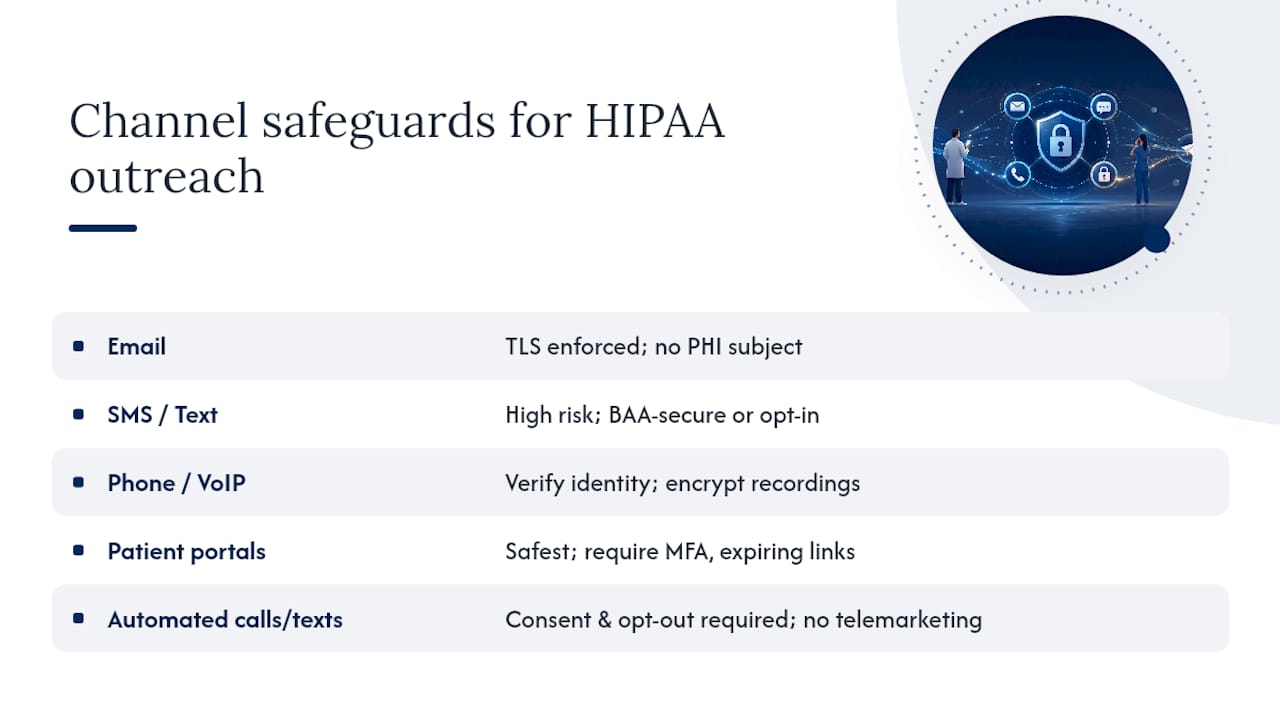
Email requires TLS enforcement on every hop. Never put PHI in a subject line, and route messages to a secure portal automatically if TLS negotiation fails.
SMS/text is the riskiest default channel because standard SMS lacks native encryption. Treat it as high risk unless you’re using a BAA-backed secure texting platform. Otherwise, limit content to appointment reminders and portal links, and capture explicit opt-in before the first message goes out.
Phone and VoIP calls demand identity verification before any PHI is discussed. Keep voicemails minimal (“please call our office regarding your appointment,” never diagnosis or treatment detail), and encrypt call recordings, since recorded calls become ePHI the instant they’re stored.
Patient portals remain the safest channel for sensitive content. Require MFA, enforce session timeouts, and use expiring one-time links in any email or text that references the portal.
The FCC and HIPAA both permit certain automated healthcare calls and texts to wireless numbers, but only with verifiable consent, working opt-out mechanisms, and no telemarketing content mixed in.
What Must Be in a Vendor’s BAA Before You Send PHI?
No vendor touches PHI, ePHI, or even a patient phone number tied to a health context, without a signed Business Associate Agreement in place first. Providing PHI to any outreach vendor before that agreement is executed is a direct violation, not a gray area.
- Permitted uses and disclosures spelled out explicitly, not left to inference.
- Breach notification timelines, ideally 24 to 48 hours, written into the contract rather than left to the vendor’s discretion.
- Return or destruction clauses covering what happens to PHI when the contract ends.
- Subcontractor flow-down language ensuring any downstream vendor is bound by the same terms.
- Evidence package: SOC 2 Type II report, penetration test summaries, encryption specifications, and audit log access on request.
- Operational commitments covering access revocation speed, role-based access enforcement, and data retention limits.
Don’t assume a telecom or messaging vendor is a mere “conduit” exempt from BAA rules. If they store call recordings, voicemails, or logs, they’re a business associate, full stop.
Which Technical Safeguards Actually Matter?
Encryption and access control aren’t optional extras bolted onto an outreach platform. They’re the baseline.
- Encryption: AES-256 at rest, and TLS 1.2 or higher (1.3 where available) in transit. Attachments need message-level encryption, not just transport security.
- Access control: unique user IDs, mandatory MFA, role-based permissions, automatic session timeouts, and IP allowlisting for admin consoles.
- Logging and DLP: immutable audit logs that can’t be edited after the fact, export controls on reports, and automated DLP rules that catch PHI before it lands in a subject line or free-text field.
- VoIP specifics: SRTP or TLS for call media, encrypted storage for recordings, and secure handling for any AI-generated transcription.
Pro Tip: Ask vendors to show you their audit log, not just describe it. A vendor that can’t produce a sample log on demand probably doesn’t have one worth trusting.
How Do You Operationalize Consent and Verification?
Technology enforces rules; people follow procedures. Both have to work together, and procedural gaps, not encryption gaps, cause most outreach violations.
- Build a consent vault: time-stamped, channel-specific opt-ins with documented risk acknowledgments for any channel carrying elevated risk.
- Verify identity with two identifiers before discussing PHI on an outbound call, date of birth plus the last four of a patient ID, or a callback to the number already on file.
- Gate your templates: pre-approve every outreach message and lock the system so staff can’t freelance PHI into a text or voicemail.
- Train by role, not blanket policy, and run simulated misdirect drills so staff recognize a wrong-number or wrong-recipient scenario before they send.
What Happens When Something Goes Wrong?
Detection starts with monitoring: alerts for unusual send volumes, unexpected data exports, and spikes in failed deliveries, all feeding into a centralized logging system.
- Contain by suspending the campaign, revoking vendor credentials, and isolating affected systems immediately.
- Investigate using immutable logs to map exactly which PHI elements were exposed and how far the exposure spread.
- Notify according to the Breach Notification Rule, and hold vendors to the 24 to 48 hour notification clause in their BAA.
- Prove it with consent records, signed BAAs, approved templates, and staff training attestations ready for an auditor.
| Audit-Ready Evidence | Why It Matters |
|---|---|
| Signed BAAs per vendor | Confirms legal authorization before any PHI access |
| Time-stamped consent records | Shows opt-in existed before each message |
| Immutable audit logs | Establishes what happened and when |
| Training attestation records | Demonstrates staff knew the procedures |
Where Compliant Outreach Programs Actually Break Down
Most breach post-mortems trace back to metadata, not message content. A voicemail transcript, a call log export, a chatbot conversation history, all of it is ePHI, and teams routinely forget to apply the same controls to logs that they apply to the original message.
Technical compliance without procedural enforcement is a false sense of security. AES-256 encryption doesn’t stop a staffer from reading a diagnosis into a voicemail. The programs that hold up under audit are the ones that default to portal-first delivery for anything sensitive, keep SMS and email to bare-minimum reminders, and automate consent capture so it isn’t dependent on someone remembering to log it. That’s a trade-off, not a shortcut, since portal-first delivery asks more of the patient upfront. But it’s the trade-off that survives an OCR investigation.
— Marc
How RevRing Supports Compliant Patient Outreach
RevRing gives healthcare outreach teams the infrastructure this checklist demands, without forcing a rebuild of your entire workflow. The platform is built with a signed BAA available, encrypted call recording, and role-based access with MFA baked into the predictive dialer and telephony stack, so encryption and access control aren’t things your IT team bolts on separately.
Consent workflows and audit logging run natively inside RevRing’s healthcare industry playbooks, which means opt-in capture, template gating, and immutable logs are part of the deployment, not an afterthought your compliance officer has to chase down later. Teams that have scaled from a dozen agents to 180 report staying compliant through that growth precisely because the controls scale with the seat count instead of requiring reconfiguration at every stage. If you’re evaluating how your current outreach stack measures up against the checklist above, schedule a live demo and walk through your specific vendor gaps with the RevRing team directly.
Sources
This article is general information, not a substitute for advice from a qualified doctor. Consult a qualified healthcare professional about your own circumstances before acting on anything here.