Cut Clinic No Shows Nearly in Half in 90 Days

Risk-targeted, two-way outreach beats blanket reminders every time the two get compared head to head. A before-and-after study across 135,393 appointments cut no-shows from 20.82% to 10.25% by pairing predictive risk scores with live staff calls, and a randomized trial confirmed the same pattern. Pair that targeting with effortless rescheduling and most clinics can realistically expect a meaningful, durable drop in missed visits.
TL;DR:
- Focusing on targeted, high-risk patient outreach through live calls can nearly halve no-shows, especially when combined with effortless rescheduling options.
- Tracking appointment no-show rates by segment and behavior provides a clearer baseline for measuring improvement and tailoring interventions.
- Implementing a layered approach—predict, triage, call, reschedule, backfill—yields better results than relying solely on reminders or penalties.
- Building simple risk flags and a streamlined workflow for staff reduces operational gaps and improves appointment adherence over time.
- Engagement tactics like personalized visit framing and easy online scheduling contribute significantly to reducing missed visits, especially in high-risk patient groups.
Table of Contents
- What Is the Best Strategy for Appointment No Show Reduction?
- How Do You Calculate Your No-Show Rate?
- How Do You Identify and Reach High-Risk Appointments?
- Do Reminder Systems Actually Reduce No-Shows?
- How Do You Build a Waitlist and Backfill System?
- Which Access Barriers Cause the Most Missed Visits?
- What KPIs Should You Track Every Week?
- Turning Study Design Into a Working Clinic Playbook
- What Actually Gets Patients to Engage With Their Care?
- Do Fees and Rewards Actually Change Attendance?
- How Should Staff Be Trained to Reduce No-Shows?
- What Do Patient Surveys Reveal About Why Visits Get Missed?
- What Should You Actually Expect in the First 90 Days?
- How RevRing Puts This Playbook Into Production
- Primary Studies Worth Reading Next
- Sources
- FAQ
What Is the Best Strategy for Appointment No Show Reduction?
Appointment no show reduction works best as a layered system, not a single tactic. Clinics that stack the right interventions in the right order consistently outperform those betting on one fix, according to practice-based synthesis across multiple reviews. Here’s the priority order, ranked by impact versus effort:
- Measure your baseline first. You cannot fix what you have not segmented by visit type, lead time, and patient history.
- Target high-risk appointments with live outreach. A short list of predictive flags, followed by an actual phone call, delivers the largest single gain.
- Run a two-way, multi-channel reminder cadence. Confirmations that require a reply outperform one-way blasts for anyone flagged as elevated risk.
- Make canceling and rescheduling nearly frictionless. One tap in a portal or text thread recovers capacity that a rigid phone-tree system loses.
- Automate your waitlist and backfill process. Every canceled slot should refill itself before staff notice it’s open.
- Remove structural barriers. Telehealth, extended hours, and transport support solve the no-shows that reminders can’t touch.
- Monitor KPIs weekly. No-show rate by appointment type, contact rate, and slots recovered tell you whether the system is working or drifting.
Notice what is missing from that list is penalties as the first move. Financial deterrents show weaker, less consistent results than operational fixes like frictionless rescheduling, according to MGMA’s 2025 guidance. Start with the top three items above. They account for most of the recoverable ground.
How Do You Calculate Your No-Show Rate?
The formula is simple, but most clinics get the denominator wrong. No-show rate equals the number of missed appointments divided by total scheduled appointments, multiplied by 100. The tricky part is deciding what counts.
A true no-show is a patient who neither attended nor canceled before the visit. A late cancellation, typically inside a 24-hour window, is a related but distinct event and should be tracked separately, since it reflects a different behavior and often a different fix. Blending the two muddies your baseline and makes pilot results impossible to trust.
- Pick a measurement window. Sixty to ninety days gives you enough volume to smooth out weekly noise without going stale.
- Segment by at least three dimensions. New versus returning patients, appointment type (well visit, specialist follow-up, procedure), and booking lead time all behave differently.
- Calculate a rate for each segment, not just a clinic-wide average, because a 6% overall rate can hide a 22% rate in your Monday-morning specialty slots.
- Track the trend, not just the snapshot. A single month’s number tells you less than an eight-week trend line.
Primary care and specialty clinics commonly see rates anywhere from 5% to 30% depending on population and appointment type, which is exactly why a single blended figure hides more than it reveals.
How Do You Identify and Reach High-Risk Appointments?
The single biggest lever in this entire playbook is targeting. A randomized controlled trial found that adding live telephone outreach on top of standard automated reminders significantly lowered no-shows among patients flagged with a predicted risk of 15% or higher, and it also narrowed attendance disparities across subgroups. That’s the mechanism worth copying: automation handles the many, humans handle the few who actually need a human.
You don’t need a data science team to start. A handful of practical signals will get you most of the way:
- Two or more prior no-shows in the past 12 months
- Appointment booked more than 14 days out
- New patient with no prior visit history
- Known transportation or scheduling conflicts flagged in intake notes
- Missed the previous confirmation attempt entirely
Pro Tip: Build your first risk list with simple “if/then” rules in a spreadsheet before you buy any predictive model. Validate the rule-based list against three months of real outcomes, then decide whether a purchased model earns its cost.
Timing matters as much as targeting. A reminder sequence that works for high-risk patients typically runs a confirmation at seven days out, a live call at three days out for anyone still unconfirmed, and a same-morning check-in. Calling everyone erases the ROI; calling no one erases the result.
If you’re evaluating a vendor’s predictive model, ask for its local calibration data, not just a headline accuracy number. A model trained on someone else’s patient population can look impressive on paper and still perform poorly on yours. Tools like a predictive dialer built for risk-driven outreach can route the flagged list straight to a live agent queue without a separate manual export step.
Do Reminder Systems Actually Reduce No-Shows?
Yes, but the effect is smaller and more uneven than most marketing claims suggest. A systematic review of 61 studies found reminders are commonly effective, though results vary widely by channel, timing, and message content. Some analyses put the pooled relative improvement around 11%, a real gain, but not the dramatic swing that risk-targeted live outreach produces on its own.
Telephone reminders often outperform SMS, though SMS remains cheaper to scale, so most clinics land on a hybrid cadence rather than picking one channel exclusively. A workable sequence looks like this:
- Seven days out: automated SMS or email with a one-tap reschedule link
- Three days out: two-way confirmation requiring a reply for anyone not yet flagged high-risk
- One day out: live call for high-risk patients; automated reminder for everyone else
- Morning of: short SMS check-in with the office number visible
Not every appointment needs a two-way confirmation. Routine, low-lead-time visits with a low-risk history do fine with a one-way reminder. Save the reply-required format for new patients, long-lead-time bookings, and anyone with a prior miss on file.
Message framing moves the needle almost as much as channel choice. Reminders that invite a reply or explicitly offer an easy reschedule option outperform flat, one-way “you have an appointment” texts, according to behavioral-economics research on appointment non-attendance.
Automated interactive voice response can handle simple confirmations at scale, but it can’t replace a live call for a patient who has already missed twice. IVR confirms; humans problem-solve. Confusing the two roles is where a lot of reminder programs quietly underdeliver.
How Do You Build a Waitlist and Backfill System?
Rescheduling friction is the quiet no-show driver nobody tracks well. If canceling requires a phone call during business hours, some patients simply won’t show up instead. MGMA’s guidance treats effortless rescheduling as a higher priority than penalty policies, and the operational math backs that up.
- Build a one-tap cancel and reschedule flow inside your existing SMS thread or patient portal. The minimum viable version is a single link with two buttons: “Reschedule” and “Cancel.”
- Trigger the waitlist automatically the moment a slot opens, rather than waiting for a staff member to notice a gap on the schedule.
- Set a backfill priority rule. First-available works for routine visits; clinical priority should override it for anything time-sensitive.
- Contact recovered slots within 24 hours. Practice reports consistently note that same-day or next-day outreach to fill a canceled slot recovers meaningfully more capacity than delayed rebooking attempts.
Clinics with online self-scheduling see the payoff downstream: one observational study found a median no-show rate of 1.8% for online-booked appointments versus 5.9% for offline bookings—a benefit explored in detail in Why Your Storage Website Is Not Getting Leads, which discusses practical strategies for improving online booking conversion. Booking friction and no-show risk move together.
Which Access Barriers Cause the Most Missed Visits?
Not every no-show is a scheduling problem. Some are access problems, and no reminder cadence fixes a patient who has no ride to the clinic.
- Transportation gaps — mitigate with rideshare vouchers or partnerships; moderate effort, high plausibility of impact for patients who flag this barrier.
- Inflexible clinic hours — extended evening or weekend blocks help working patients; higher staffing effort, targeted impact.
- Long wait times between booking and visit — shorten lead time where possible; low effort, meaningful impact for new-patient segments.
- Distance or mobility limitations — telehealth substitution where clinically appropriate; low effort, but evidence on telehealth’s effect on no-shows is mixed and depends heavily on visit type.
- Language or communication gaps — bilingual reminder templates and staff; moderate effort, high impact for affected populations.
Telehealth deserves a caveat instead of a blanket endorsement. It helps most with routine follow-ups and medication checks, and helps far less with visits requiring hands-on exams. Rolling it out clinic-wide without segmenting by visit type risks trading one access barrier for a different attendance problem. Track telehealth no-show rates separately from in-person rates before assuming it solved anything.
What KPIs Should You Track Every Week?
A dashboard only earns its place if it changes behavior, not just displays numbers. Track these on a weekly cadence:
- No-show rate by appointment type, not a single blended figure
- Contact rate for reminder outreach, meaning the percentage of patients actually reached, not just messaged
- Slots recovered through waitlist backfill each week
- High-risk list size and what percentage received a live call
Set a simple trigger: any patient who accumulates two no-shows in a rolling 90-day window gets automatically added to the high-risk list and assigned a staff navigator for their next booking. That single rule does more work than most standalone reminder upgrades.
Run small experiments monthly rather than overhauling everything at once. Test a live call against a text-only reminder for one week’s worth of high-risk slots and compare outcomes. Separately, test two message framings, one emphasizing the visit’s value and one simply offering an easy reschedule link, and see which pulls a higher reply rate. Small, measured tests beat clinic-wide guesses.
Turning Study Design Into a Working Clinic Playbook
Every effective study in this space follows the same five-step sequence: predict, triage, call, reschedule, backfill. Translating that sequence into clinic operations means assigning each step to a role and a piece of technology, not just writing it on a whiteboard.
- Predict: a risk model or rule-based list flags appointments likely to be missed.
- Triage: front-desk or a scheduling coordinator reviews the flagged list daily.
- Call: a staff member or automated dialer reaches high-risk patients with a live conversation, not just a text.
- Reschedule: a one-tap flow captures the cancellation before it becomes a silent no-show.
- Backfill: an automated waitlist fills the freed slot without manual intervention.
A platform combining automated risk flagging, blended calling, and CRM connectivity illustrates one way to run this entire sequence without stitching together five separate tools. RevRing’s healthcare workflows are built around exactly this kind of integrated automation-plus-human-outreach model, offered here as one example implementation, not the only path.
Clinics running this on a smaller budget can build the same sequence with a spreadsheet risk list, a shared calendar, and a part-time scheduler making the calls. The mechanics of predict, triage, call, reschedule, and backfill matter more than which vendor executes them.
What Actually Gets Patients to Engage With Their Care?
Reminders tell a patient when to show up. Engagement explains why it’s worth showing up, and clinics that skip that second half leave a real gap in their attendance strategy.
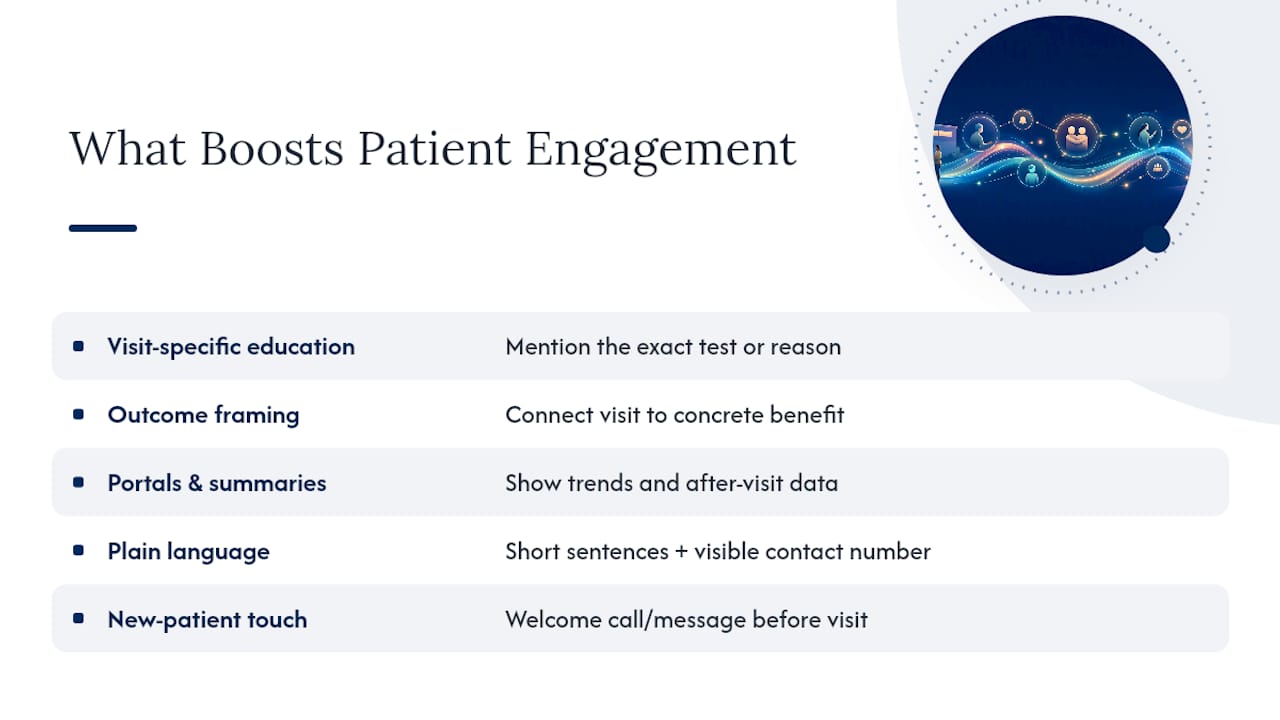
Patient education works best when it’s specific to the visit type, not generic. A reminder for a diabetes follow-up that mentions the actual lab result being checked tends to land differently than a flat “you have an appointment” text. Framing that connects the visit to a concrete outcome, catching a problem early, adjusting a medication, avoiding a repeat test, gives patients a reason beyond compliance.
Portals and after-visit summaries extend that engagement past the appointment itself. A patient who can see their own trend lines, blood pressure over six visits, weight over a year, arrives at the next appointment with more buy-in than one who only hears numbers read aloud once a year.
Language and literacy matter more than most reminder systems account for. A confirmation text written at a reading level that assumes health literacy the patient doesn’t have will get ignored, not misunderstood, ignored. Plain language, short sentences, and a visible phone number for questions consistently outperform clinical phrasing in reply rates.
New patients need a different engagement touch than returning ones. A first-time patient who has never met the provider has less invested in the relationship, which is part of why new-patient segments so often show the highest no-show rates in baseline data. A short welcome call or message explaining what to expect at the first visit closes some of that gap before the appointment ever happens.
Do Fees and Rewards Actually Change Attendance?
Financial penalties for missed appointments feel like an obvious lever, and plenty of clinics reach for one first. The evidence for penalties alone is thinner and more inconsistent than the evidence for operational fixes, and MGMA’s guidance explicitly ranks easy rescheduling above penalty policy as the higher-priority fix.
Part of the problem is that a no-show fee punishes the visit that already happened. It does nothing to prevent the next one unless the patient changes behavior specifically because of the fee, and for patients missing visits due to transportation or scheduling conflicts, a fee just adds a barrier on top of the original one.
Incentives work more reliably in narrow contexts, small reminders framed around a benefit (“keep your care on track”) rather than a reward payment. There isn’t strong published evidence that cash incentives for attendance scale well in general outpatient settings, and the administrative cost of running a rewards program often outweighs the benefit for smaller practices.
If a clinic does use a penalty structure, pair it with a grace period and a clear rescheduling path. A patient who gets hit with a fee and no easy way to rebook is a patient who may not come back at all. The fee should be a backstop for genuinely unengaged patients, not the primary strategy, sitting well behind risk-targeted outreach and frictionless rescheduling in priority order.
How Should Staff Be Trained to Reduce No-Shows?
The best risk model in the world fails if the front desk doesn’t know what to do with the flagged list it produces. Staff training is the connective tissue between the data and the outcome, and it’s the step most clinics underinvest in.
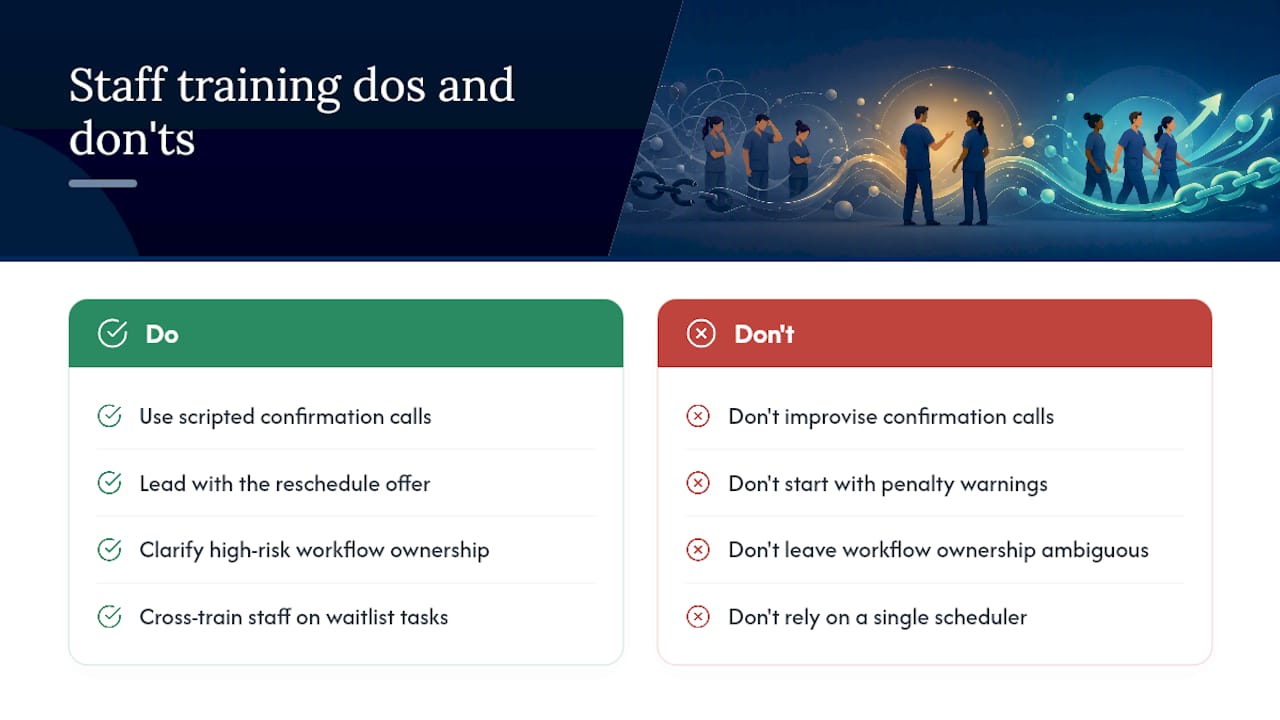
Scripted confirmation calls work better than ad-lib ones, not because improvisation is bad, but because a consistent script ensures every high-risk patient gets offered the same reschedule option and the same plain-language explanation of why the call is happening. Train staff to lead with the reschedule offer, not a warning about penalties.
Workflow clarity matters as much as script quality. Every staff member touching the schedule should know exactly who owns the high-risk list, when it’s reviewed, and what happens after a call, logged in the CRM, flagged for a supervisor, or triggering an automatic waitlist entry. Ambiguity here is where good models die in practice; the list gets generated but nobody actually calls it.
Cross-training front-desk staff on basic waitlist mechanics prevents bottlenecks. If only one scheduler knows how to backfill a canceled slot, that knowledge gap becomes a capacity leak the moment that person is out sick. Build the waitlist workflow so any trained staff member can execute it in under two minutes.
Regular short huddles, five minutes at the start of a shift, reviewing yesterday’s no-shows and today’s high-risk list keep the system from drifting back to broadcast reminders out of habit. Momentum on this kind of program erodes fast without a standing check-in.
What Do Patient Surveys Reveal About Why Visits Get Missed?
Every clinic tracking no-shows eventually hits the same wall: the data tells you who missed, not why. That’s where structured patient feedback earns its place in the playbook.
A short post-no-show follow-up, a text or call asking what got in the way, surfaces patterns that risk scores can’t. Transportation issues, work conflicts, forgotten appointments, and confusion about the visit’s purpose all show up as the same data point in a scheduling system but require completely different fixes.
Exit surveys after successful reschedules are just as valuable as no-show follow-ups. Ask patients who almost missed but rebooked what nearly stopped them from coming. That near-miss group often reveals friction points, a confusing portal, an inconvenient time slot, a fee they weren’t sure applied, before those points cause an actual missed visit for someone else.
Feedback only changes outcomes if it’s routed somewhere. Feed root-cause themes back into the risk list rules quarterly. If a growing share of no-shows in one segment trace back to a specific barrier, transportation, say, that’s a signal to add a targeted mitigation for that segment rather than another generic reminder. Root-cause data is the feedback loop that keeps the entire system from calcifying around assumptions made a year ago.
What Should You Actually Expect in the First 90 Days?
A realistic target for most clinics running this playbook well is a meaningful relative drop in no-show rate within the first quarter, concentrated almost entirely in the high-risk segment you’re actively calling. Broadcast reminders alone rarely move the needle this fast; targeted outreach does.
This is your quick win window.
Weeks 5 to 8: Layer in the two-way reminder cadence and launch the one-tap reschedule flow. Watch contact rate, not just no-show rate, as your early signal.
Weeks 9 to 12: Turn on automated waitlist backfill, review root-cause feedback themes, and run your first A/B test on message framing or channel.
The biggest pitfall: expanding live calls to everyone instead of keeping them reserved for the flagged segment. That’s how ROI quietly disappears.
— Marc
How RevRing Puts This Playbook Into Production
Revring is built around the exact sequence this article just walked through: predict, triage, call, reschedule, backfill, without stitching five separate tools together to get there.
The platform connects a predictive dialer for the live-call step, blended inbound and outbound calling for staff who need to reach high-risk patients directly, and CRM connectivity so a flagged appointment, a completed call, and a rebooked slot all live in one record instead of three disconnected systems. For healthcare specifically, that connectivity comes wrapped in HIPAA-aware compliance infrastructure, including BAA support, so outreach automation doesn’t create a compliance gap while it closes a scheduling one.
A sensible path in: start with a live demo to see the predictive dialer and AI automation layer in action, run a small pilot on one high-risk segment, then scale once you’ve validated the lift on your own patient population. Plans start at $39.99 per month per seat on the Starter tier, with Scale and Pro tiers adding deeper automation as your outreach volume grows. If your team is currently running risk lists manually or relying on a single automated reminder tool, a turnkey platform like this removes the integration work of building predict-to-backfill yourself. Check the healthcare industry page for the specifics that apply to your practice.
Primary Studies Worth Reading Next
- Before-and-after study, 135,393 appointments: predictive model plus staff outreach cut no-shows nearly in half.
- Randomized controlled trial: live outreach for high-risk patients significantly outperformed automation alone.
- Systematic review of 61 studies: reminders help, but effects vary sharply by channel and message design.
- Observational scheduling study: online booking correlates with far lower no-show rates than offline booking.
Check any vendor’s claims against these sources before signing a contract. Marketing copy tends to round up; peer review doesn’t.
Sources
- Real-Time Analytics and AI for Managing No-Show Appointments in Primary Health Care in the United Arab Emirates: Before-and-After Study
- Randomized trial of targeted live telephone outreach for patients at high predicted no-show risk
- Behavioural economic interventions to reduce health care appointment non-attendance: a systematic review and meta-analysis
- Impact of online appointment scheduling on no-show rates (observational practice study)
FAQ
How Can I Reduce the Number of No-Show Appointments?
Start by segmenting your no-show rate by appointment type and identifying your highest-risk patients using simple flags like prior no-shows or long booking lead times. Then add live phone outreach for that segment on top of your existing reminders, a combination randomized trial evidence shows outperforms automated reminders alone.
What Happens if I Don’t Show Up for an Appointment?
Most practices log the missed visit, and some apply a no-show fee after a grace period or repeated misses, though fee policies vary widely by clinic. Missing an appointment can also affect your priority on rescheduling or trigger a follow-up call from staff checking on what happened.
How Do You Calculate an Appointment No-Show Rate?
Divide the number of missed appointments by total scheduled appointments in your measurement window, then multiply by 100.
Can You Bill for No-Show Appointments?
Billing insurance for a no-show is generally not permitted since no service was rendered, but many practices can charge the patient directly through a stated no-show fee policy, subject to state regulations and payer contract terms. Frictionless rescheduling tends to prevent more missed revenue than fee collection recovers, according to MGMA guidance.
What Is a Good No-Show Rate for a Clinic?
Segments with long lead times or new patients often run higher, sometimes 15% to 20%, which is exactly why segment-level benchmarking matters more than one clinic-wide number.