Pilot to Scale Adherence Tracking for Regulated Teams, with Revring

Agent adherence tracking is the practice of comparing what an agent is scheduled to do against what they actually do, minute by minute, then flagging gaps before they become compliance or service failures. For insurance, real estate, legal, and healthcare teams, it protects both the customer experience and the audit trail regulators expect. The fastest way to start: publish accurate schedules mapped to system statuses, pick three to five KPIs, and run a pilot running for a few weeks before scaling.
TL;DR:
- Maintaining data accuracy is crucial, requiring regular schedule audits, prompt reconciliation of changes, and human review of auto-classified adherence to avoid false flags.
- Setting conservative thresholds with tolerance bands and recovery windows helps prevent alert fatigue and ensures managers respond only to meaningful deviations.
- Integrating telephony, CRM, and AI data in real-time and batch workflows provides a holistic view necessary for reliable adherence tracking.
- Clear ownership of remediation actions and transparency with agents foster trust and prevent morale issues caused by perceived surveillance.
- A gradual 90-day rollout focused on data quality, narrow pilots, and real-world threshold tuning leads to sustainable adherence management and positive operational impact.
Table of Contents
- Quick Operational Checklist to Set Up Agent Adherence Tracking
- What Metrics Actually Define Agent Adherence?
- How Do You Collect and Unify Adherence Data?
- Setting Thresholds Without Triggering Alert Fatigue
- Turning Adherence Data Into Coaching and Staffing Decisions
- Implementation Example: How Regulated Teams Run This With Revring
- Privacy and Compliance Considerations When Tracking Agent Adherence
- How Does Adherence Tracking Affect Employee Engagement?
- Best Practices for Keeping Adherence Data Accurate
- Common Pitfalls in Agent Adherence Tracking
- Author Perspective: What Realistic Success Looks Like at 90 Days
- Start an Adherence Tracking Pilot With Revring
- Authoritative Docs and Papers to Read Next
- Sources
- FAQ
Quick Operational Checklist to Set Up Agent Adherence Tracking
You don’t need a six-month rollout plan to start measuring adherence. You need a clean pilot with a tight scope and someone accountable for what the data shows.
- Publish schedules first. Map every scheduled activity (calls, breaks, training, case review) to the exact system statuses your telephony or CRM platform reports.
- Choose 3 to 5 primary KPIs and lock a 14 to 30 day pilot window before touching a single threshold.
- Integrate telephony, CRM, and workforce management (WFM) events into one feed rather than reviewing three separate reports.
- Set initial thresholds conservatively and name one person who owns remediation for each flagged gap.
- Build a coaching and compliance reporting cadence before the pilot ends, not after.
Pro Tip: Run your first pilot on one team or shift, not the whole floor. A narrow pilot surfaces data-quality problems (bad timestamps, missing schedule entries) while the stakes are still low.
What Metrics Actually Define Agent Adherence?
Adherence percentage is the foundation: time spent in adherence divided by total scheduled time, expressed as a percentage. An agent scheduled for 8 hours who spend 7.5 hours in the right status is running at 93.75% adherence. Most platforms also track raw in-adherence minutes alongside out-of-adherence (OOA) time, tagged by cause, so a manager can tell the difference between a late login and an extended unplanned break.
For teams running AI-assisted intake or scoring, adherence data needs company beyond the clock:
- Task success / completion rate — did the workflow or call resolve what it was supposed to?
- Escalation rate — how often cases kick up to a supervisor or specialist
- Tool-call accuracy — for AI-assisted flows, whether the system invoked the correct action or lookup
- Correlated operational KPIs — average handle time (AHT), occupancy, and CSAT, read alongside adherence rather than in isolation
Agentic operations guidance sets sample service-level targets worth adapting: task success at 95% or higher, tool-call accuracy at 90% or higher, and hallucination rate capped at 3%, with escalation rate held at 5% or below.
Single incidents rarely mean much. A 15 minute adherence dip during a system outage is noise. Three consecutive shifts trending downward is a pattern that deserves a coaching conversation.
How Do You Collect and Unify Adherence Data?
Adherence tracking is only as good as the data feeding it, and that data usually lives in four separate systems that were never built to talk to each other.
Core data sources:
- Telephony / call detail records (CDR) for actual talk time and call status
- CRM timestamps for task starts, completions, and status changes
- WFM schedule and status events for planned activity
- AI audit logs for agent-assist scoring and automated decision events
Fields every feed needs: agent ID, scheduled activity, actual activity, start and end timestamps, time in state, and any guardrail flags triggered along the way.
The most workable pattern combines two speeds: a real-time stream feeding live dashboards and supervisor alerts, plus a nightly batch job that reconciles schedule edits and produces historical reports. Amazon Connect’s adherence documentation notes that adherence recalculates automatically when a schedule changes within the historical window, and that unscheduled work gets excluded from the calculation entirely rather than counted as a violation.
Watch for three recurring failure points: time zone mismatches across distributed teams, unscheduled work that never gets logged, and shifts that simply never made it into the WFM system in the first place.
Setting Thresholds Without Triggering Alert Fatigue
A binary “in adherence or not” model breaks down fast in real operations. Someone stepping away for 90 seconds to grab a document shouldn’t trigger the same alert as a 20 minute unexplained absence.
Amazon Connect’s schedule adherence model handles this with activity-level thresholds, configurable Start Early and Start Late windows, and an allowable variance in minutes for each scheduled activity. That granularity matters more than most teams realize when they first set up tracking.
Rather than firing an alert on every deviation, build in tolerance bands and short recovery windows so agents have a chance to self-correct before a supervisor gets pinged. Guidance on agent-quality metrics backs this approach for both human and AI-assisted workflows, recommending drift thresholds instead of hard triggers.
Not every alert needs escalation. Some just need a logged ticket.
- Coaching ticket for a first-time or minor gap
- Automated schedule adjustment for recurring, explainable patterns
- Direct supervisor page only for sustained or repeated breaches
Pro Tip: Track your alert-to-action ratio monthly. If fewer than one in three alerts leads to a real managerial action, your thresholds are too tight and your team will start ignoring the system.
Turning Adherence Data Into Coaching and Staffing Decisions
Data that never reaches a coaching conversation is wasted infrastructure. The adherence gantt and OOA-cause widgets should be the first thing a team lead opens each morning, not a report that gets pulled once a month for a compliance file.
- Prioritize coaching sessions using the causes behind out-of-adherence time, not just the raw percentage
- Give managers and QA role-based scorecards so everyone is working from the same numbers instead of competing spreadsheets
- Use multi-week adherence trends to inform staffing and shift design, not just individual performance reviews
- Baseline a handful of leading indicators before scaling headcount, so a growth spurt doesn’t quietly erode compliance
Unifying human and AI-agent metrics on one scorecard lets managers prioritize coaching and tuning actions across both workforce types instead of treating automated and human work as separate universes.
Implementation Example: How Regulated Teams Run This With Revring
Revring built its lead generation infrastructure around a simple problem: insurance, real estate, and healthcare teams run compliance, telephony, CRM, and AI scoring on separate tools that don’t share data. That fragmentation is exactly what breaks adherence tracking before it starts.
Revring’s industry playbooks for healthcare and adjacent regulated sectors are built to slot into existing workflows rather than force a rebuild, which cuts the internal resistance that usually kills a new monitoring rollout in its first month. Clients running these playbooks have reported scaling from 12 to 180 agents while maintaining compliance controls throughout the growth curve, rather than bolting compliance on after the fact.
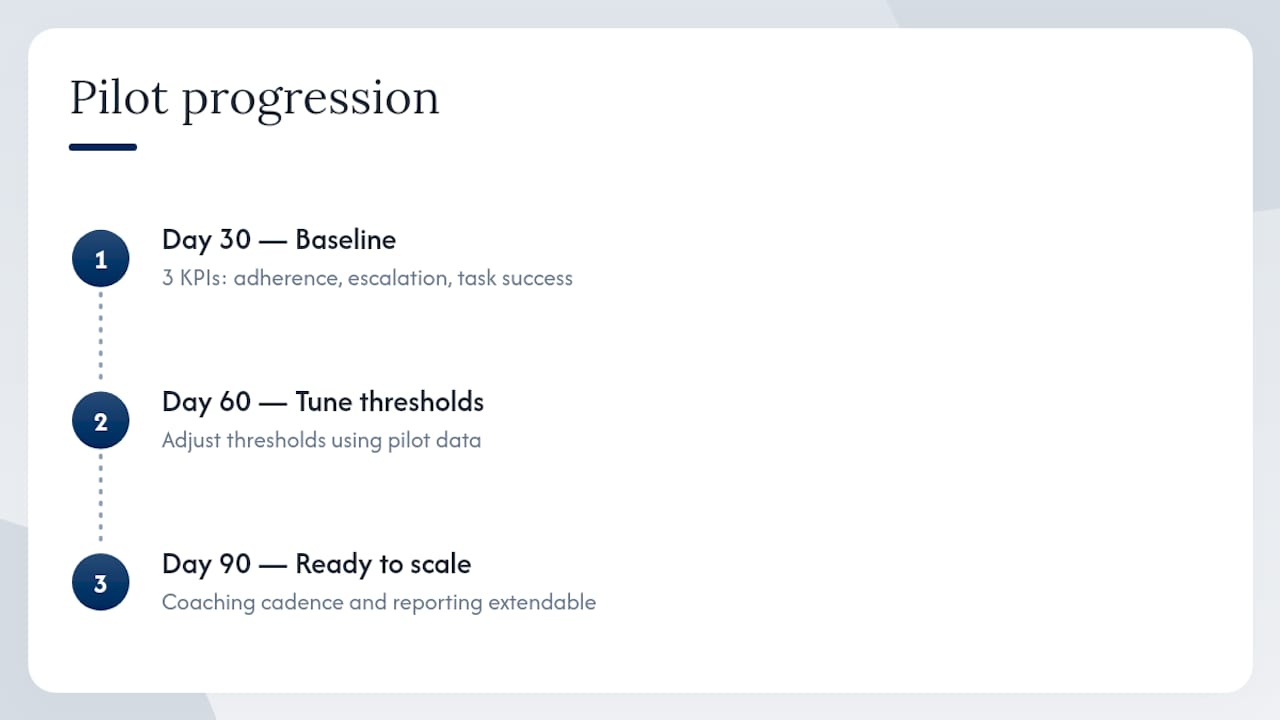
A workable pilot configuration: one team, one shift, three KPIs (adherence percentage, escalation rate, task success), running for a few weeks. At day 30, you should see a stable baseline and your top two or three OOA causes identified. At day 60, thresholds get tuned against real data instead of guesses. At day 90, the pilot’s coaching cadence and reporting format should be ready to extend to the next team.
Privacy and Compliance Considerations When Tracking Agent Adherence
Adherence tracking touches employee monitoring law the moment you start logging timestamps, activity states, and audio or call metadata tied to a named agent. That puts it squarely in workplace privacy territory, and the rules vary by state and by industry.
Healthcare teams handling protected health information need adherence systems that respect HIPAA boundaries, particularly around who can access logs that might reference patient interactions. Insurance and financial teams working under TCPA rules need call and consent records that stand up to regulatory review, which means adherence data and compliance data often need to live in the same audit trail rather than separate silos.
A few practical guardrails matter regardless of sector:
- Disclose monitoring practices to employees in writing before rollout, not after a dispute
- Limit access to raw adherence logs to the managers and compliance staff who actually need them
- Keep audit logs tamper-evident so a regulator or internal auditor can trust the timeline, not just the summary numbers
- Retain data only as long as your compliance obligations require, and document the retention schedule
Legal teams tracking case-intake adherence face a similar tension: attorney work product and client confidentiality rules can limit what activity data gets logged, even when the underlying schedule adherence question is purely operational. When in doubt, loop in compliance or legal counsel before finalizing what fields get captured, not after the system is already collecting them.
How Does Adherence Tracking Affect Employee Engagement?
Adherence tracking has a reputation problem. Agents who hear “we’re tracking your adherence” often assume it means constant surveillance and zero trust, and that assumption alone can dent morale before the system ever produces useful data.
The fix isn’t hiding the monitoring. It’s framing it honestly and using it the way it’s meant to be used: to protect agents from unfair blame, not to catch them in gotcha moments. An agent who gets flagged for a 20 minute adherence gap that was actually a system outage benefits from a transparent log just as much as their supervisor does.
A few things tend to determine whether adherence tracking builds trust or erodes it:
- Transparency about what’s measured. Agents should know exactly which activities count toward adherence and which don’t, before the first alert ever fires.
- Tolerance bands over binary judgment. A system that treats a two minute bathroom break like a policy violation will train agents to resent the dashboard.
- Coaching framed as support, not discipline. The same OOA-cause data that flags a problem should also be used to fix broken schedules or unrealistic staffing.
- Visibility both ways. Agents who can see their own adherence numbers in real time tend to self-correct faster than agents who only hear about problems in a monthly review.
Teams that skip the transparency step often see adherence tracking correlate with turnover spikes, not because the metric itself is unfair, but because it lands as surveillance rather than a shared tool. The data should feel like a mirror the agent can check anytime, not a trap set by management.
Best Practices for Keeping Adherence Data Accurate
Bad data produces bad coaching decisions, and adherence systems are unusually easy to poison with small errors that compound over weeks. A misconfigured time zone on one shift can quietly make an entire team look non-compliant for a month.
Start by auditing your schedule source. If WFM schedules are entered manually and inconsistently, no amount of downstream reporting sophistication will fix the root problem. Cross-check scheduled activities against system status codes regularly. Codes drift over time as new call types or workflow steps get added, and if the mapping isn’t updated, agents get flagged for activities that were never actually out of adherence.
Reconcile schedule changes promptly. When a supervisor approves a shift swap or an unplanned schedule change, that edit needs to flow back into the adherence calculation, or the system will penalize agents for following an adjustment nobody logged. Amazon Connect’s model addresses this by recalculating adherence whenever a schedule changes within the historical window, which is the standard most platforms should be held to.
Keep tamper-evident audit trails for every adherence event. If an agent disputes a flagged gap, the log needs to show exactly what happened, when, and who reviewed it. That protects both the agent and the compliance team when a regulator or auditor asks for evidence.
Finally, sample your automated adherence classifications with a human review on a rolling basis. Systems that auto-tag OOA causes can misclassify edge cases, and catching that drift early prevents a small labeling bug from becoming a pattern of unfair coaching.
Common Pitfalls in Agent Adherence Tracking
Most adherence tracking programs don’t fail because the technology is wrong. They fail because of predictable, avoidable setup mistakes.
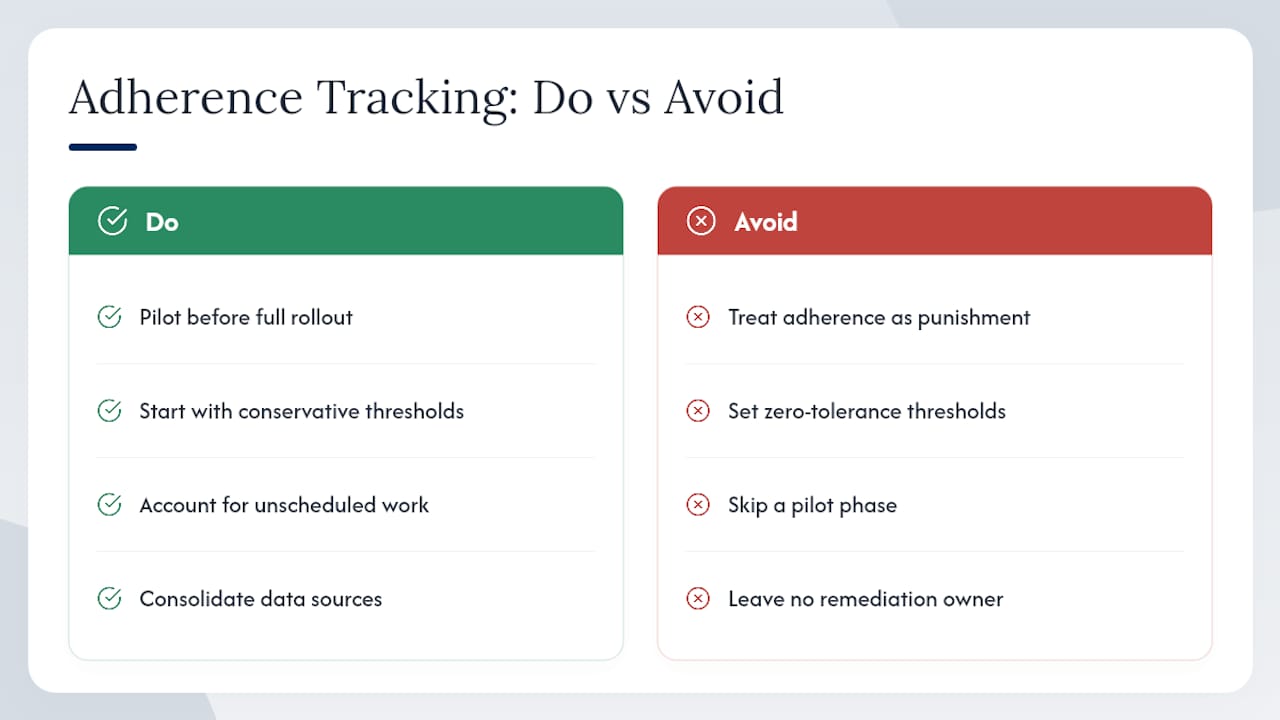
Treating adherence as a punishment metric. Programs that lead with discipline instead of support burn trust fast, and agents learn to game the system rather than genuinely improve.
Setting thresholds too tight, too early. A brand-new program with zero-tolerance thresholds generates so many alerts that supervisors start ignoring them within the first week. Start conservative and tighten gradually as data quality improves.
Ignoring unscheduled work. Legitimate ad hoc tasks, urgent client calls, compliance reviews, get miscounted as adherence violations when the schedule wasn’t built to account for them.
Skipping the pilot phase entirely. Rolling adherence tracking out to an entire department at once means any data-quality problem gets amplified across dozens of agents simultaneously instead of caught in a controlled test group.
Fragmented data sources. When telephony, CRM, and WFM data live in three disconnected systems, managers end up reconciling reports by hand, and reconciliation errors get mistaken for real compliance gaps.
No clear remediation owner. A dashboard full of flagged gaps means nothing if no one is accountable for acting on them. Effective adherence monitoring pairs every alert with a named remediation path, whether that’s a coaching ticket, a schedule fix, or a supervisor conversation.
The common thread across all of these: adherence tracking works when it’s built gradually, with clean data and clear ownership, not when it’s deployed as a compliance checkbox on day one.
Author Perspective: What Realistic Success Looks Like at 90 Days
Most adherence rollouts fail from rushing the threshold-setting stage before the data is even clean. The right sequence is data quality first, a narrow and conservative pilot second, and only then a push toward broader thresholds and automation. Leading indicators, like override trends and early-stage plan adherence, tell you more in week two than a polished dashboard tells you in month three. Ninety days in, success looks unglamorous: fewer disputed flags, a shrinking OOA-cause list, and a team that trusts the numbers enough to act on them without a fight.
— Marc
Start an Adherence Tracking Pilot With Revring
Getting adherence tracking right means unifying data that usually sits in three or four disconnected tools, and that’s the exact problem Revring’s platform was built to solve. The platform connects telephony, CRM, and AI scoring into one compliance-ready ecosystem, so adherence data, compliance controls, and coaching workflows all live in the same system instead of requiring manual reconciliation every week.
Before scoping a pilot, gather your current schedules, a list of the system statuses your telephony and CRM tools already report, and the three to five KPIs your team cares most about. If you’re running outbound-heavy operations, Revring’s predictive dialer captures call-level events natively, and the AI automation module logs agent-assist scoring so tool-call accuracy and task success feed directly into your adherence reporting. For teams evaluating any AI feature in a sales stack, it’s worth reviewing how to test AI capabilities beyond the vendor demo before committing to a full rollout.
Request a walkthrough of the platform to see how a pilot maps to your specific compliance requirements, whether that’s insurance lead intake, real estate follow-up, or healthcare case management.
Authoritative Docs and Papers to Read Next
- Microsoft Dynamics 365’s adherence tracker documentation covers Gantt-chart visualization and adherence summary metrics.
- Amazon Connect’s schedule adherence guide details threshold configuration and real-time versus historical reporting.
- The devfloor9 agentic metrics playbook explains task success, tool-call accuracy, and faithfulness scoring for AI-assisted workflows.
- NICE’s adherence report documentation illustrates dashboard widgets like variance scatter plots and OOA-cause breakdowns.
Sources
- Use the adherence tracker - Microsoft Dynamics 365
- Schedule adherence - Amazon Connect
- Agentic metrics — devfloor9 engineering playbook
FAQ
What Is Agent Adherence Tracking?
Agent adherence tracking measures how closely an agent’s actual work activity matches their scheduled activity, typically expressed as a percentage of scheduled time spent in the correct status.
How Do You Calculate Adherence Percentage?
Divide time spent in adherence by total scheduled time, then convert to a percentage. Platforms like Amazon Connect also let you configure allowable variance minutes so minor timing gaps don’t count as violations.
What’s a Reasonable Adherence Threshold to Start With?
Most teams start with tolerance bands rather than a hard number, since binary thresholds tend to trigger excessive alerts early on.
Does Adherence Tracking Apply to AI-Assisted Workflows?
Yes. AI-assisted flows need additional metrics like tool-call accuracy and hallucination rate alongside traditional adherence percentage, since correctness matters as much as timing.
How Can Regulated Teams Keep Adherence Tracking Compliant?
Disclose monitoring practices to employees, limit log access to those who need it, and maintain tamper-evident audit trails. Platforms like Revring build compliance controls like TCPA and HIPAA safeguards directly into the same system that tracks adherence, which keeps regulated teams from managing separate compliance and monitoring tools.